10/26/2008

The Sensei delivers super ass-kicks to anti-gay haters

It's the Seattle Queer Film Festival and I managed to catch a couple of really good movies. Here's a review of the new movie, the Sensei, that I wrote for the Northwest Asian Weekly. It's a great movie which weaves in Asian Am identity, the challenges of being queer in a small town, and the taboos against HIV/AIDS. I love it for being so unique. It's not simply an "issue" film. It feels organic and ties together the "issues" as they are in regular, undramatized, daily life...
It helps that Dianna Lee Inosanto, the lead character/director/producer is amazingly beautiful and a superb martial artist. She is the goddaughter of Bruce Lee and daughter of Dan Inosanto!
Anyways, here's a youtube and the review. Enjoy!!


Here's the article:

Diana Lee Inosanto describes herself as a multi-tasker. The Filipino American stuntwoman, martial arts instructor, actress and mother of two is also the writer and director of a new independent movie, “The Sensei.” Screened in packed theatres at numerous film festivals, “The Sensei” will be playing in the upcoming Seattle Gay and Lesbian Film Festival on Oct. 24.

Lee Inosanto is the daughter of Dan Inosanto, acclaimed martial arts instructor and student of Seattle’s legendary Bruce Lee. Affectionately, she said of her god-uncle, “Uncle Bruce was a role model of diversity for me. He broke down a lot of racial barriers in the ’60s and ’70s. He was a Chinese guy and he hung out with Japanese, Hispanic, Black and Muslim people. He echoed a turn in the time.”

Today, Lee Inosanto echoes the changing perceptions towards sexuality and HIV/AIDS. Carrying on the tradition of breaking down barriers, “The Sensei” tackles with the often unspoken and taboo topics in broader society and martial arts scenes. The harsh experience of an isolated gay youth in the 1980s is central to the movie. He lives in a small town in Colorado and feels the need to learn self defense to protect himself. Unpretentious and occasionally blood chilling, the topics of heterosexism and HIV/AIDS are wide open in the film.

It is not surprising, given that one of the main inspirations of the film was the tragic hate-crime murder of Matthew Shepard in 1998. Attacked and brutalized by two homophobic men, Shepard was killed while tied to a fence, his corpse mistaken for a scarecrow.

“His story came at a time when my cousin came out as a lesbian,” said Lee Inosanto. The timing of the two events made Shepard’s death feel close to home.

“The Sensei” protagonist McClain Evan’s story, however, differs drastically from Shepard’s. Faced with isolation and depression, Evan’s character, played by Michael O’Laskey II, seeks strength and martial arts skills from Lee Inosanto’s Karen O’Neil. With compassion, O’Neil takes on homophobia and trashes it of all its destructive assumptions.

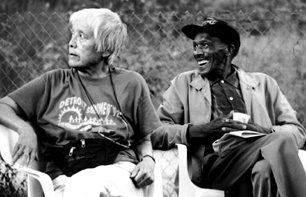
The inspiration for O’Neil’s strength comes from Gilbert Johnson, renowned co-author of Bruce Lee and Dan Inosanto’s books. Johnson, a straight heterosexual man, was diagnosed with HIV/AIDS at the height of anti-gay, anti-AIDS sentiments in the 1980s.

“(Johnson) came out (about being HIV-positive) to the notoriously conservative martial arts scene. It was unheard of,” said Lee Inosanto. Recalling how she respected his ability to overcome his own prejudices and march alongside gay activists, Lee Inosanto added, “(Johnson) left a huge impact on my life.”

Produced on a tight budget, Lee Inosanto’s “The Sensei” was a challenge to fund. Referring to producers who did not understand her film, Lee Inosanto chuckled as she said, “They wanted to make it into a B martial arts film, thinking it could (be) some late night HBO, dragon-style dramatic movie. I wanted to protect my film.”

Her sense of ownership led her and her husband, co-producer Ron Balicki, to seek independent funding sources. When a major investor, repelled by topics that the film was addressing, backed out, the two were left with seeking alternative funding sources, even partially refinancing their home to make up the budget. After seven years of determination, “The Sensei,” a unique film that intricately weaves in Asian American identity, sexuality and the meaning of community, sets itself apart from the rest.

10/20/2008

Queer Muslims in tha house, Stand Up!

We blogged about the movie, Jihad for Love, a couple weeks ago here. Democracy Insurgent, the Middle East solidarity group that we are organizing these days, also co-hosted the screening of the movie at the Independent South Asian Film Festival, Tasveer. The director, Parvez Sharma showed up for the screening as well and held a Q and A session afterward, which he seemed to enjoy immensely! Our friend and co-organizer, Afrose, MC-ed the event. It was a very politically sharp and insightful opening to the film, which helped to highlighht the political aspects of the film, and framed it as QUEER MUSLIM film, and not some Irshad-Manji-style apologist kind of movie, which Parvez himself admitted some people mistook his film for. Parvez, btw, loved the opening and said it was the best he had had for the film...impressive!

Attached here is her speech. We are waiting on the video clip to come in. So till then, strain those eyes and read out loud to you, and your queer/queer-loving friends!

Also check out Parvez Sharma's blog here. It records reactions to his film, both heartfelt positivities and nasty negativities.

10/19/2008

Capitalism in crisis, from Iraq to the US

This is our latest flyer.
All those of you readers who are in Seatown, we'd love to see you there!

SAVE THE DATE: OCT 28th, 7pm, University of Washington HUB 209 A
email us if you need directions!

10/17/2008

Jalan Journal...finally!!


Our new pan-Asian journal is finally up. The URL is....*drumrooooolll*


Named after my dead dog which was featured in one of the earlier posts

Jalan in Malay means "to walk" or "street"

So you see Jalan Tupai = Tupai Street; Jalan Petaling = Petaling Street. You get the point. (That street, btw, is a source of my counterfeit brands in KL)

You also say, let's go jalan jalan. Much like we say lets go makan. The two actions balance each other out. Go walk, then eat!

Like this blog, Jalan Journal aims to project a sense of pan-Asian unity and liberation. We take seriously the struggles of everyday Asian folks against white supremacy and capitalism. Sometimes we wage wars against our own elites, who have aligned themselves with the most demeaning and shameful forces to pit us against each other and other working people of color. We project this sense of unity without compromising on gender and queer liberation. Third world feminism inspires us and keeps us rooted, pushing us to always seek renewed visions of freedom.

Anyways, hope folks can go check out the journal and give us some feedback!

Thanks to all the writers and also to our most beloved web-techie!

What's cooking in South Korea?

Here's a link to an interview with an organizer with All Together, a Korean socialist organization, about the exciting summer of mass mobilization that just took place. It captures the movement dynamics that have taken place in SK, as well as the slowness of the left in responding to the spontaneous actions of the people. I think it's great how the organizer points out that this slowness arises largely from the elevated sense of self that the Left has, thinking that most everyday people are bought off by capitalism, until they get super shocked when things turn out in a way they dont expect, and can't respond to in time. The interview frames the election of the neo-liberal right-wing Lee Myung Bak, not so much as evidence of South Korean people shifting right as a whole, but more so as a punishment to the failure of the liberal imperialist parties of Kim Dae Jung and Roh Moo Hyun. There's a lot that can be learned from this piece.

The article also highlights the dynamic relationship that revolutionary organizations (like All Together), can have to the spontaneous movements of everyday people. It shows clearly that a movement is sparked off in large part because of a spontaneous action, yet an excessive focus on spontaneity as a movement continues, can be unsustainable. What sometimes arises is a lack of direction of the movement. All Together's participation and leadership in the movement did not destroy its spontaneity -- hundreds of thousands still came out to the rallies -- but it was able to try to push for a strong political focus, which tried to subvert the government's framing of the rally. The South Korean government kept trying to frame the rally as a "political" one, as opposed to the worker unions' "economic" agenda. The government's division of "economic" and "political" was a deliberate attempt to divide the ranks between workers and the rest of society. I see the South Korean government's attempt at framing this huge, massive, successful rally this way, as how official society tries to divide and conquer us amongst ourselves, even in our most successful times (infuriating!!). There is a need to contend for power and leadership in those situations, and All Together tried to do just that. Unfortunately, among other reasons, the trade union bureaucracy (KCTU) was too rooted in these similar "workerist" divisions and the movement wasnt able to cohere a strong sense of working class rebellion.

Anyway, once again, it means so much to me to see that folks in SK are moving!! So much for the model minority/Asian Tiger myth of docile and passive Asians! Check the interview out here.

Also, other articles by All Together, translated into English:
On the South Korean Left
Formation of North Korean capitalism
Was North Korean economy in crisis in the 1950s?
North Korea in the 1950s: Capital accumulation and power struggles

Seattle anti-war rally Oct 11th


Here's a quick update on an anti-war rally that we participated in. Khalil, our fellow organizer, spoke at the rally and I can fairly say that he was the best speaker for the most part. There was a personalized aspect to his speech that highlighted a sense of Arab and Muslim liberation and resistance, even while recognizing its obstacles. It reminded me alot of the civil rights speeches. Unfortunately, the audience wasn't too big. Another reason why we need to organize to get this movement going!

Our flyer:


Here are two websites for the curious:
http://seattle.indymedia.org/en/2008/10/269478.shtml
http://www.youtube.com/profile_videos?user=indolin

10/05/2008

In Commemoration of JB Jeyaretnam

With the death of JBJ, Singapore might just have earned a political symbol of resistance to the government.

Not that there haven't been any before -- the history of Singapore Malaya is loaded with freedom fighters who were crushed and forgotten. Now, we are left only with a revisionist history of our nation's founding.

Most folks reading this probably dont know the significance of JBJ. He is a figure who is very local to Singapore. Still, it is important for me to write about him here, even if briefly. I will say he was a bourgeois politician, who believed in at best, a British system of parliamentary democracy in Singapore, who saw the ruling party PAP botch even that ideal. Nonetheless, he fought for what he believed in despite a lot of repression, against a very formidable and unscrupulous government. The Singapore government's method of repression is always "clean." It seldom involves outright repression -- beating and torture. That would garner too much attention and wreck the image of Singapore being the only uncorrupted, clean, efficient nation in the chaos of Southeast Asia. Rather, it is through clandestine ways, such as dragging political activists out in long drawn-out court battles, fines, etc that would cause them to declare bankrupcy and create a whole lot of emotional and financial stress...thus making it IMPOSSIBLE to organize, IMPOSSIBLE to pool resources together in the absence of any functional grass roots organizations which if ever were present, had been effectively squashed by the government.

I remember seeing JBJ give out pamphlets and giving speeches in front of Centerpoint, in Orchard Road, when I was growing up. I had no idea that those simple acts, and others that had the intention of stirring up opposition to the ruling party, would get him sued and eventually cause him to file for bankrupcy. He was often seen as a looney, giving out flyers to a somewhat apathetic, and largely fearful audience. Fearful of the "Singapore swing," where it was popularly believed that any criticism of the government would get one arrested by Internal Security, basically detention without trial, reserved for political activists. To his credit, JBJ didn't give up and was always butting heads with the government. He built up organizations, bourgeois political parties that would compete against the government during election times. He belonged to that older generation of Singapore and Malaysia whose memories I wish I could tap, to understand what went on in those tumultuous 1960 days.

RIP Mr. JBJ.


picture taken from Yawning Bread